Press release —
Analogue or digital? The right load cell for the right application
Which load cell technology is right for your application? This technical article explains why the answer depends not on trends, but on the specific process requirements. Find out what strengths analogue and digital load cells offer, where their respective advantages lie, and how operators can find the most cost-effective and technically optimal solution for their plant.
Digitalisation is increasingly transforming industrial production. In weighing technology, silo and plant manufacturers, as well as producers, are faced with the question of whether analogue or digital load cells are the better choice for their applications. However, the answer is more nuanced than it might seem at first glance: “Both technologies have their merits,” says Yannick Salzmann, Product Manager at Minebea Intec. “Which solution is best, depends on the specific process requirements, the environmental conditions and the long-term operational objectives.
Analogue load cells: Proven precision for demanding industrial applications
Load cells have formed the backbone of industrial weighing systems for decades. They operate using strain gauges and deliver an analogue voltage signal. In analogue load cells, this signal is processed by the downstream weighing electronics, whereas in digital load cells, it is digitised directly within the load cell itself.
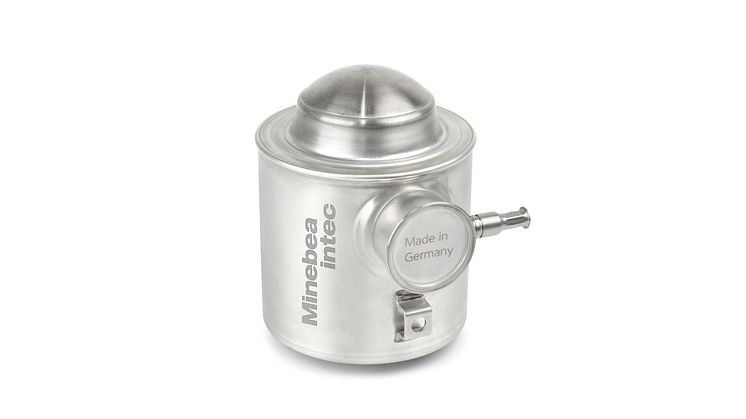
A typical example of this technology is the Inteco® PR 6203 compression load cell. It is primarily used in tank, silo and process weighing and is suitable for applications where reliability, long-term stability and robustness are required. With load ranges of 500 kg to 75 t, it covers numerous applications in the chemical, food, pharmaceutical and building materials industries.
Particularly in demanding production environments, operators benefit from the simple tried-and-tested system architecture of analogue weighing systems. Maintenance staff are familiar with the technology, spare parts are available long term and the investment costs are often lower than digital solutions.
A clear example is provided by the speciality chemicals manufacturer Grace. There, analogue compression load cells from Minebea Intec have been used for decades for weighing silos and process vessels. The systems continuously monitor fill levels during the production process and support the automatic transfer of batches to downstream finished-product silos. Particularly in the chemical industry, where corrosive environmental conditions and high plant availability play a key role, analogue load cells excel thanks to their long-term stability, robust construction and ease of maintenance.
“Analogue load cells have proven their worth in many industrial applications over the decades. When robustness, ease of maintenance and long-term availability are the main priorities, they often remain the most cost-effective solution,” explains Yannick Salzmann.
On the other hand, the limited diagnostic capabilities are a drawback. As the measurement signals are processed centrally, the causes of faults can often only be identified by carrying out additional on-site measurements. Furthermore, the condition of individual load cells cannot be monitored directly at all times.
Digital load cells: transparency and diagnostic capability in industrial environments
As industrial plants become increasingly networked, digital load cells are gaining in importance. Here, signal processing takes place directly at the load cell, enabling the measured values to be transmitted digitally.
One example of this is the Pendeo® Truck PR 6224B digital truck scale load cell. It was developed specifically for truck scales and offers advanced diagnostic and communication capabilities. Weight readings from individual load cells are immediately available, which simplifies commissioning, fault diagnosis and service.
“Digital load cells offer particular advantages when a high level of transparency regarding the condition of the system is required. The ability to evaluate individual load cells separately simplifies both commissioning and diagnostics during operation,” explains Yannick Salzmann.
Furthermore, digital systems can be integrated more easily into modern automation and condition monitoring concepts. These features make digital load cells particularly attractive for large truck scales and networked industrial plants.
However, these advantages are offset by certain challenges. Greater functionality often goes hand in hand with a more complex infrastructure and higher investment costs. Not every application requires the advanced diagnostic and networking functions, meaning that analogue solutions remain the more cost-effective alternative in many cases.
It all depends on the application
Analogue and digital load cells are not competing but complementary technologies. Whilst analogue systems impress with their simple architecture, robustness and cost-effectiveness, digital solutions offer additional transparency and extensive diagnostic capabilities.
When weighing containers in harsh environments where long-term stability is a priority, an analogue solution such as the Inteco® PR 6203 may be the ideal choice. For truck scales or networked systems where system availability and condition monitoring are of paramount importance, a digital solution such as the Pendeo® Truck PR 6224B can demonstrate its strengths.
Technology-neutral consultancy assistance as a key to success
For operators, this means one thing above all: the selection of the right load cell technology should not be based on technology trends. “Our experience shows that the best solution is rarely evident from the data sheet alone,” says Yannick Salzmann. “It is the interplay of process requirements, environmental conditions and economic objectives that ultimately determines which technology offers the greatest long-term benefit.” As a manufacturer of industrial weighing and inspection technologies, Minebea Intec offers both analogue and digital load cell solutions. This enables users to adopt a technology-neutral approach and select the solution best suited to their specific process, depending on the application scenario.
The crucial question is therefore not ‘analogue or digital?’, but rather: Which technology best meets the requirements of the specific application?
Topics
Categories
Minebea Intec is a leading global manufacturer of industrial weighing and inspection technologies. Headquartered in Hamburg, Germany, the company offers products and services that have stood for innovation, performance and reliability for more than 150 years. The product portfolio includes high-resolution platform scales, load cells, hopper and silo scales, checkweighers, metal detectors, X-ray and visual inspection systems as well as intuitive software solutions. Over 900 employees at 18 locations increase the precision and efficiency of industrial customers' weighing and production processes. A network of 215 partners in 67 countries complements the global player's sales and service locations. The high performance and distinctive German quality are reflected in the brand promise "the true measure".
Minebea Intec is part of the MinebeaMitsumi Group, a leading supplier of high-precision production parts such as ball bearings and motors as well as high-quality electronic components such as sensors, antennas and IoT solutions. The Group, which is headquartered in Tokyo and has around 81,000 employees worldwide, reported consolidated net sales of 1,644,387 million yen (approx. 9.5 billion euros) for the 2026 financial year.